Tuesday, November 30, 2010

A Comedic Tragedy

               Every so often I have come across things in textbooks that make no sense to me, and that is no different for the classifications of drama.  Drama can be broadly split into two categories, comedy and tragedy, which I agree with, most movies- since that is as close to plays as teenagers see- fall into those categories.  It’s what those topics entail that I do not understand.  Comedies are supposed to highlight human failure to get the audience laughing while the tragedy is supposed to highlight human greatness.  I’m not sure what society is presenting now, but it doesn’t fall within that definition anymore, it seems backwards now.  Today’s comedies always end happy, I cannot think of a movie that made me laugh but left me disappointed with the main character and aware of its flaws or flaws in the human race.  I can’t think of a sad movie that I walked out of either that left me admiring the main character in anyway- I usually just want to forget about the story and move on.
                The arts we are presented with now seem much more black and white divided between these categories.  Comedies are funny, have happy endings and tie up all storylines.  Tragedies are usually not funny. More emotional and dramatic, and have a tendency to leave the viewer drained.  Think about the past few movies or- if you have had the opportunity- plays.  They wall within these new divisions don’t they?  Perhaps older plays follow this pattern closely, but for now, to me it seems that today this definition seems outdated.  Honestly, I am glad the ideas presented in these two types have changed.  I really don’t want to watch a comedy that makes me think about humanity or a tragedy that makes me cry, and perhaps that this is why the two have evolved.  Most people want mindless entertainment that they can walk out of happy-and I think I can live with that.
Emily S.

Sunday, November 28, 2010

THANKSGIVING BREAK :)

 I was assigned to blog during Thanksgiving break (yes!) so I decided to blog about Thanksgiving and what it really means.  Most people know the origins of Thanksgiving - the joint celebration between the Pilgrims and the Indians.  Many, however, don't know the deeper meaning of this holiday.  We have feasts and eat until we can't breathe anymore, without realizing why we feast and what it means.  Originally, the Indians saved the Pilgrims who had just arrived in Massachusetts, from starvation.  They helped them harvest and cultivate, which is why we have a feast on Thanksgiving day.  We also celebrate this day on the fourth thursday of every November because that signifies the day of harvest.  The help that the Indians gave the Pilgrims was so significant, and the Pilgrims were truly thankful, which is why the day is called Thanksgiving day not Feast day.  Beyond the delicious food and family gatherings, Thanksgiving is really about being grateful and appreciative of what we've been given, just as the Pilgrims were.  So even though Thanksgiving is over for this year, hopefully we'll be able to keep in mind for the next years to come, why we celebrate Thanksgiving, and not only look foward to the food and family, but really think about how blessed we all are in so many different ways.


<3 Lisa L.

Some Confusion, the Fusion to Make an Allusion, which Will Produce the absolute Conclusion

Words Words Words. " A unit of language, consisting of one or more spoken sounds or their written representation, that functions as a principal carrier of meaning." Words allow communication and the ability to express one's emotions. And when certain words are linked together they give meaning to actions whether it be in an expression, in a conversation, as a verb, adjective, noun, or can even describe other words. So why is it so hard to write an essay on words? 
1. There are too many words in the English language. 
2. The correct word for a specific event and emotion always seems to be replaceable by a better and greater word.
3. The ability to write beautiful poetic versus about three such charismatic, microscopic roots and/or affixes is pretty much one of the most confusing things I have ever done in English.


 (I think the essay would have come more naturally if we had just written about the word word.LOL)


But after thinking about what I wanted to write about, hidden emotions, I decided that this was a good opportunity to refresh my memory of how words can be manipulated to sway an emotion of the reader or question what is ethically or morally correct. This reminded me of reading Julius Caesar by William Shakespeare in Mr.Weidman's sophomore class, which is about Julius Caesar and Marcus Brutus in 44 BC and the events leading up to Caesar's assassination. The way Shakespeare presented his characters in a time of chaos is phenomenal because people begin to show their true colors. But when the reader looks at it more in depth, Brutus, being swayed by his peers to kill Julius Caesar, actually swayed the reader to think this is morally incorrect while still feeling sorry for Brutus. And when Marc Antony gave his inspirationally speech on finding and killing the assassins the audience is overcome by feelings of coming together as one and justice and unmorality for wanting to kill the killers. I had forgotten how Shakespeare had a way with words and a gift of one-liners. And after rereading this tragedy I recognized that there was a lot of repetition of words and reoccurring themes that were portrayed. I wanted to be able to write the 'word' essay and bring out emotions, although it word be nothing like Shakespeare's literature, at least it would still be an emotion-full work of literature.


So in the end I obviously wrote the three word essay which turned into a five word, four paged, three days of my life, two times falling asleep while writing, and one time submitting essay and I like it. So if anybody else had difficulties writing an essay on words your not alone.


-Vaness C.


Tuesday, November 16, 2010

Mary Shelley: a literary prodigee?

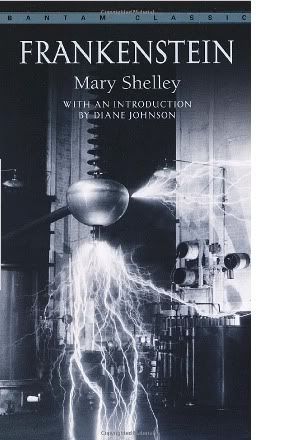
--Frankenstein is one of the most famous pieces of literature in all of history.  The weird part about it, is that Shelley created this story not for publishing, but to win a friendly competition between some of her peers.  As the manuscript was passed around, it eventually became publish; Shelley was only 21 years old.  How many 21 year olds do you know that write literature in such a way that it survives through the ages?
     This week in class, we have learned how to write Literary 3X3's.  These are tiny plot overviews consisting of three sentences, made up of only 3 words.  The guidelines consisted of no repeating words and expanded vocabulary.  By forcing us to use such few lines, but at the same time incorporating meaningful words, we really had to dig deep to find the right words to correctly describe the text we have read.  This also tied back into last weeks meaningful word study.  Here was our teams 3X3:
                                                    Knowledge inspires existance.
                                                    Thus comes fear.
                                                    Life implements death.
What was your team's literary 3X3?

Tuesday, November 2, 2010

All We Need Is Love

When Victor goes by himself up into the snowy mountains he unexpectedly runs into the monster he had created. As their conversation ensues I find myself feeling more empathetic towards the monster than Victor. The monster all but falls to his knees and pleads to his creator to love him yet the only emotion he recieves is pure hatred from the man who is supposed to have more humanity than he does. Victor, who was already becoming an increasingly bothersome character, is, in my opinion, even less of a human than the supposedly ugly and heartless monster. Though before I still had hope that he would end his egotistical rants, I now believe it is part of Shelley's message to leave him as is. So as the monster relates his whereabouts to Victor in the coming chapters, I will find it very surprising if Victor changes his mind about the creator he himself created.
-Sapir L.